The Aegis Node.
The permanent, solar-autonomous backbone of the mesh network. Engineered for indefinite operation in zero-infrastructure environments.
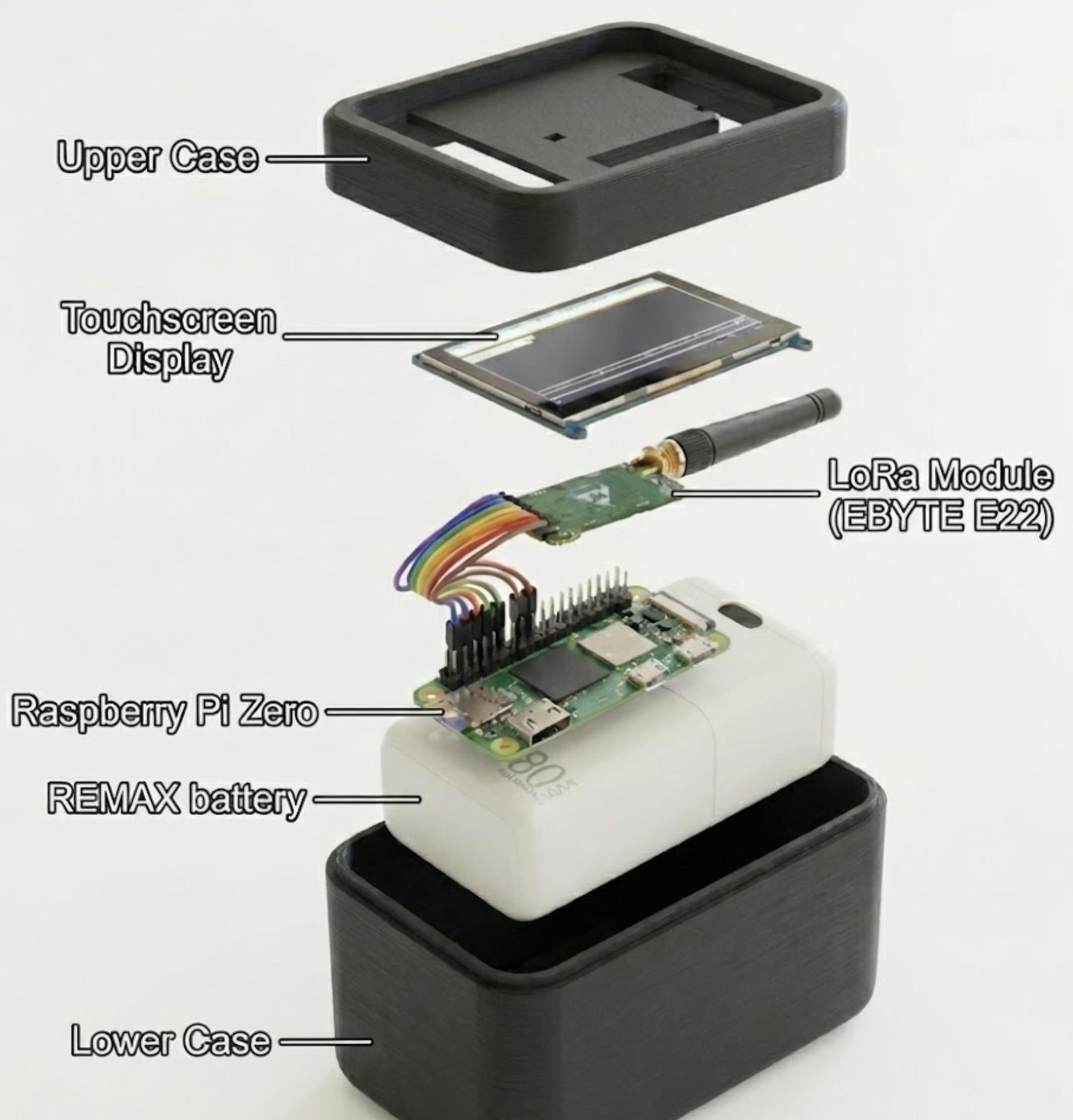
// FIG 1.0: MODULAR INTERNAL ARCHITECTURE
System Architecture
Key subsystems powering the independent mesh.
- Housing (Development Phase) Current V4 field units utilize 3D-printed reinforced ABS for rapid iteration. Final production tooling will transition to IP67-rated, UV-stabilized injection molding with integrated gaskets.
- High-Gain LoRa Antenna Omnidirectional dipole tuned for the 915/868 MHz band. Mounted externally to maximize Fresnel zone clearance and ensure 15km+ line-of-sight propagation.
- Core Logic Board (ARM Cortex) Low-power quad-core processor. Manages packet deduplication, encryption keys, and the local Wi-Fi bridge for connecting civilian smartphones.
- LoRa Transceiver (SX1262) Primary radio module. Handles the chirp spread spectrum modulation, allowing the system to demodulate signals significantly below the RF noise floor.
- LiFePO4 Energy Storage 80,000mAh capacity. Selected for thermal stability and high cycle life (2000+). Provides operational continuity during extended periods of low solar irradiance.
Engineering Specifications
Detailed metrics for system integrators.
| RF Protocol | LoRaWAN L2 (Modified Mesh) |
| Frequency Bands | US915, EU868, AS923 |
| Tx Power | Regional Limit (Hardware Max: +22 dBm) |
| Rx Sensitivity | -148 dBm |
| Processor | Broadcom BCM2711, Quad-core Cortex-A72 |
| Memory | 2GB LPDDR4-3200 SDRAM |
| Storage | 32GB Industrial eMMC |
| Local Connectivity | Wi-Fi 5 (802.11ac), Bluetooth 5.0 |
Power & Environment
Operational limits and autonomy.
| Battery Capacity | 80 Ah (256 Wh) @ 3.2V |
| Solar Input | 12-24V DC MPPT Controller (Max 60W) |
| Autonomy (No Sun) | ~6 Months (Deep Sleep Beacon Mode) |
| Operating Temp | -30°C to +65°C (-22°F to 149°F) |
| Dimensions | 280mm x 180mm x 90mm (Approx.) |
| Weight | 3.5 kg (7.7 lbs) |
Why 80,000mAh?
Standard IoT devices are designed for predictable solar cycles. We design for worst-case scenarios. Following a major event, ash or heavy cloud cover can reduce solar efficiency to near zero for weeks.
The Aegis Node's battery reservoir ensures the network backbone remains active and beaconing for half a year without recharge. This ensures a viable signal is available immediately after a disaster, not just when the weather clears.